Internal Medicine Billing and Coding: A Complete Guide to Accurate Claims and Revenue Growth
Internal medicine practices manage a wide range of adult health conditions, from routine preventive care to complex chronic diseases. Internists often treat patients with multiple medical concerns, which makes proper documentation, coding, and billing especially important.
Accurate medical billing is essential for maintaining a healthy revenue cycle. Every patient encounter must be translated into the correct codes and supported by clear clinical documentation. Errors in CPT coding, ICD-10 diagnosis selection, modifier usage, or claim submission can lead to denials, delayed payments, and unnecessary administrative work.
This guide explains the key elements of internal medicine billing and coding, including commonly used CPT codes, ICD-10-CM diagnosis codes, modifiers, common billing challenges, and practical strategies for improving claim accuracy and revenue performance.
Understanding Internal Medicine Medical Billing
Internal medicine medical billing is the process of converting healthcare services into standardized codes for insurance claims and reimbursement. These codes help payers understand what services were provided, why they were medically necessary, and how they should be processed.
A typical internal medicine claim may include:
- CPT codes for office visits and procedures
- ICD-10-CM codes for diagnoses and medical conditions
- HCPCS codes for certain supplies and Medicare services
- Modifiers when additional information is required
- Documentation supporting medical necessity
The goal is not simply to submit a claim. A successful billing process focuses on submitting clean, accurate claims that correctly reflect the care provided and meet payer requirements.
Why Is Internal Medicine Billing Complex?
Internal medicine providers frequently care for patients with multiple chronic and acute conditions during the same visit. A single appointment may involve evaluating diabetes, hypertension, high cholesterol, medication management, and laboratory results.
This complexity can create several billing challenges, including:
- Managing multiple diagnoses during one encounter
- Selecting the correct E/M service level
- Supporting medical necessity
- Billing preventive and problem-oriented services correctly
- Managing chronic care services
- Reporting transitional care management
- Following Medicare requirements
- Applying modifiers appropriately
- Understanding payer-specific policies
Because of these challenges, accurate documentation and a structured billing process are essential.
Common CPT Codes Used in Internal Medicine
CPT codes describe the services performed by healthcare providers. Internal medicine practices commonly use evaluation and management codes, preventive service codes, and care management codes.
| CPT Code | Service Description |
|---|---|
| 99202–99205 | New patient office or outpatient evaluation and management services |
| 99211–99215 | Established patient office or outpatient evaluation and management services |
| 99381–99397 | Preventive medicine services |
| 99490 | Chronic care management |
| 99439 | Additional chronic care management time |
| 99495 | Transitional care management |
| 99496 | Transitional care management with higher complexity |
These codes are examples of services frequently used in internal medicine. The final code selection should always match the services documented by the provider and follow current coding guidelines.
Office Visits and E/M Coding
Evaluation and management services are among the most common claims submitted by internal medicine practices.
Providers may see patients for:
- New patient evaluations
- Routine follow-up visits
- Chronic disease management
- Medication management
- Acute illnesses
- Diagnostic concerns
- Treatment planning
Common E/M code ranges include:
- 99202–99205 for new patients
- 99211–99215 for established patients
The appropriate E/M level should be selected based on current coding guidelines and supported by medical decision-making or total time when applicable. Complete documentation should clearly describe the patient's concerns, conditions addressed, assessment, and treatment plan.
Preventive Medicine Services
Preventive care plays an important role in internal medicine. These visits may include health maintenance, risk assessment, counseling, screening recommendations, and preventive planning.
Preventive medicine services are commonly reported using age-based CPT code ranges, including:
- 99381–99387 for new patients
- 99391–99397 for established patients
Adult internal medicine practices often use the appropriate codes within these ranges based on the patient's age and visit type.
A preventive visit is different from a problem-oriented office visit. When a significant medical condition is separately evaluated and managed during a preventive encounter, a separate E/M service may sometimes be reported if documentation supports the additional work and payer guidelines allow it.
Medicare Annual Wellness Visits
Medicare Annual Wellness Visits focus on preventive planning and health risk assessment rather than a traditional physical examination.
Common HCPCS codes include:
- G0438 – Initial Medicare Annual Wellness Visit
- G0439 – Subsequent Medicare Annual Wellness Visit
These visits may include health risk assessments, personalized prevention plans, and other required components.
Internal medicine practices should clearly distinguish between a Medicare Annual Wellness Visit, a routine preventive examination, and a problem-oriented office visit to avoid billing errors.
Chronic Care Management in Internal Medicine
Chronic care management is particularly relevant to internal medicine because many patients require ongoing care for multiple long-term conditions.
Examples may include:
- Diabetes
- Hypertension
- Heart disease
- Chronic kidney disease
- COPD
- Arthritis
Chronic care management may involve:
- Coordinating care with other healthcare providers
- Managing medications
- Communicating with patients
- Maintaining care plans
- Monitoring chronic conditions
Common CPT codes may include:
- 99490 for qualifying chronic care management services
- 99439 for additional qualifying time when applicable
Proper documentation is essential. Practices should ensure that patient eligibility, consent requirements, time requirements, and care management activities meet current revenue cycle payer guidelines.
Transitional Care Management
Transitional care management helps patients safely move from one healthcare setting to another after a qualifying discharge.
These services may involve:
- Timely communication with the patient or caregiver
- Medication review
- Coordination of follow-up care
- A qualifying face-to-face visit
- Management of the patient's recovery and ongoing needs
Common CPT codes include:
- 99495
- 99496
Because these services have specific timing and documentation requirements, billing staff should carefully review current guidelines before submitting claims.
Common ICD-10-CM Diagnosis Codes in Internal Medicine
Internal medicine providers manage many chronic and acute medical conditions. ICD-10-CM diagnosis codes help describe the patient's condition and support the medical necessity of the services provided.
| Condition | Code | Description |
|---|---|---|
| Hypertension | I10 | Essential (primary) hypertension |
| Type 2 Diabetes | E11.9 | Type 2 diabetes mellitus without complications |
| Type 2 Diabetes | E11.65 | Type 2 diabetes mellitus with hyperglycemia |
| Hyperlipidemia | E78.5 | Hyperlipidemia, unspecified |
| Hypothyroidism | E03.9 | Hypothyroidism, unspecified |
| GERD | K21.9 | Gastro-esophageal reflux disease without esophagitis |
| Chronic Kidney Disease | N18.9 | Chronic kidney disease, unspecified |
| Depression | F32.A | Depression, unspecified |
| Obesity | E66.9 | Obesity, unspecified |
These examples are commonly used in internal medicine billing. However, coders should always select the most specific diagnosis code supported by the provider's documentation.
Important Modifiers in Internal Medicine Billing
Modifiers provide additional information about a service or procedure. Correct modifier usage helps explain specific circumstances that may affect claim processing.
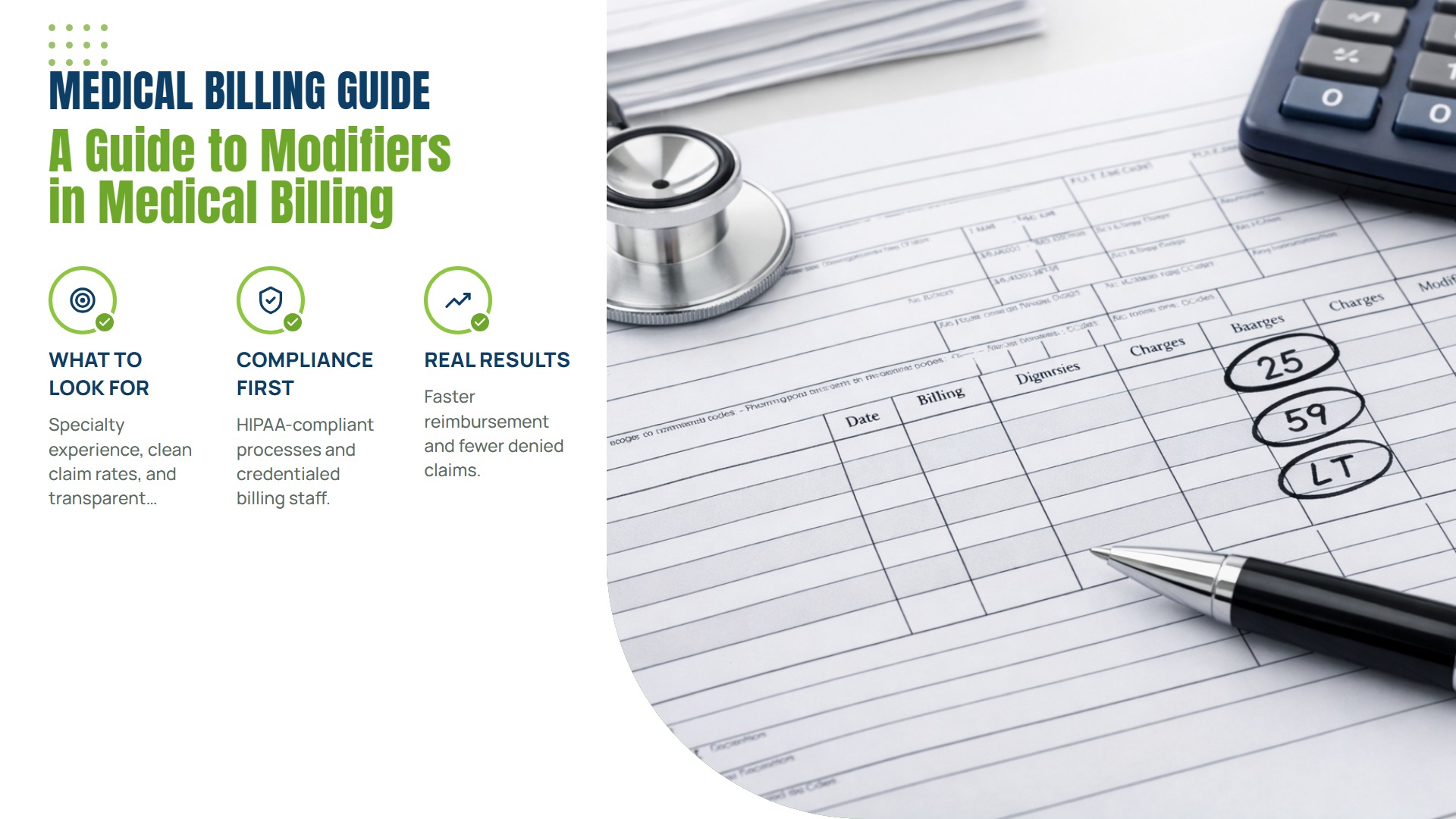
Modifier -25
Modifier -25 may be used when a significant and separately identifiable evaluation and management service is performed on the same day as another procedure or service. For example, a provider may perform a medically necessary office visit and also complete a separately reportable procedure during the same encounter. The documentation must support the E/M service as separate from the usual work associated with the procedure.
Modifier -59
Modifier -59 may be used to identify a distinct procedural service when procedures that would normally be bundled are performed separately under qualifying circumstances. This modifier should only be used when documentation clearly supports a distinct service.
Modifier -24
Modifier -24 may be used when an unrelated evaluation and management service is performed during a postoperative global period. The service must be unrelated to the procedure that created the global period.
Modifier -57
Modifier -57 may apply when an evaluation and management service results in the decision to perform certain major surgical procedures. The provider's documentation should clearly support the decision-making process.
Modifier -76
Modifier -76 may be used when the same physician or qualified healthcare professional repeats a procedure or service under appropriate circumstances.
Modifier -77
Modifier -77 may be used when a procedure is repeated by another physician or qualified healthcare professional.
Modifier -91
Modifier -91 may apply to repeat clinical diagnostic laboratory tests performed on the same day when additional results are needed.
Accurate modifier use is important because inappropriate reporting can result in claim denials and compliance concerns.
Common Internal Medicine Billing Mistakes
Billing errors can affect reimbursement and create unnecessary delays. Some common mistakes include:
Incorrect E/M Code Selection
Choosing an E/M level that does not match the documented medical decision-making or total time can create payment issues and compliance risks.
Incomplete Documentation
The provider's documentation should clearly support the diagnoses, services performed, and treatment plan.
Improper Use of Modifier -25
Modifier -25 should not be automatically added whenever an office visit and procedure occur on the same day. The documentation must support a significant and separately identifiable E/M service.
Incorrect Preventive Visit Billing
Preventive medicine visits, Medicare Annual Wellness Visits, and problem-oriented office visits have different requirements. Confusing these services can result in claim errors.
Lack of Diagnosis Specificity
Using unspecified diagnosis codes when more detailed information is available can reduce coding accuracy and lead to claim issues.
Missing Chronic Conditions
When chronic conditions are evaluated or managed during a visit, the documentation should accurately reflect the provider's assessment and treatment decisions.
Incorrect Chronic Care Management Billing
Chronic care management services have specific requirements related to patient eligibility, consent, time, and documentation.
Failure to Follow Payer Guidelines
Different insurance plans may have unique requirements for preventive services, laboratory testing, authorizations, and care management programs.
How to Reduce Claim Denials in Internal Medicine
Reducing denials requires attention at every stage of the revenue cycle. A proactive approach can help practices prevent many common errors before claims are submitted.
Verify Insurance Eligibility
Confirm active insurance coverage, benefits, copayments, deductibles, and authorization requirements before the patient visit.
Review Documentation Before Coding
Ensure that the provider's documentation supports the diagnoses and services being reported.
Use Specific Diagnosis Codes
Select the most specific ICD-10-CM code supported by the medical record.
Apply Modifiers Correctly
Use modifiers only when their requirements are met and documentation supports their application.
Follow Payer-Specific Guidelines
Review payer policies for preventive services, chronic care management, Medicare billing, and other frequently provided services.
Conduct Regular Coding Audits
Routine audits can help identify coding errors and recurring billing problems before they affect revenue.
Submit Clean Claims
Review claims for missing information, coding conflicts, demographic errors, and payer-specific requirements before submission.
Follow Up on Denials Promptly
A structured denial management process can help identify denial patterns, correct claims, and prevent similar issues in the future through consistent accounts receivable follow-up.
The Importance of Accurate Documentation
Accurate documentation is the foundation of successful internal medicine billing and coding. A complete patient record should clearly describe:
- Patient symptoms and concerns
- Relevant medical history
- Chronic conditions addressed
- Clinical assessment
- Diagnoses
- Tests ordered or reviewed
- Medications managed
- Treatment plan
- Follow-up recommendations
When selecting E/M services, documentation should support the level of medical decision-making or total time when time is used for code selection.
Clear records help improve coding accuracy, demonstrate medical necessity, and provide support during payer reviews or audits.
How Expert Medical Billing Services Can Support Internal Medicine Practices
Managing billing for an internal medicine practice can be challenging because of the wide range of services and conditions treated.
At Expert Medical Billing Services (EMBS), we help practices improve their billing workflow through services such as:
- Insurance eligibility verification
- Charge entry
- CPT and ICD-10 coding review
- Modifier validation
- Clean claim submission
- Payment posting
- Denial management
- Accounts receivable follow-up
- Chronic care management billing support
- Revenue cycle management
A professional billing process can help reduce administrative burden, improve claim accuracy, and support more consistent reimbursement.
Conclusion
Internal medicine billing and coding require careful attention to documentation, diagnosis selection, CPT codes, modifiers, and payer requirements. Because internal medicine providers often manage patients with multiple chronic conditions and complex healthcare needs, accuracy is essential throughout the entire billing process.
Successful billing is not just about submitting claims. It requires complete documentation, correct E/M code selection, specific diagnosis coding, proper modifier usage, and regular monitoring of payer policies.
By improving billing workflows and identifying errors before claims are submitted, internal medicine practices can reduce denials, improve reimbursement efficiency, and strengthen their revenue cycle. Partnering with an experienced medical billing team can also help practices manage complex administrative responsibilities while allowing healthcare providers to focus more on delivering quality patient care.
Note: CPT, ICD-10-CM, HCPCS codes, modifier guidelines, and payer policies can change. Always verify current coding guidance, official payer requirements, and documentation standards before submitting claims.